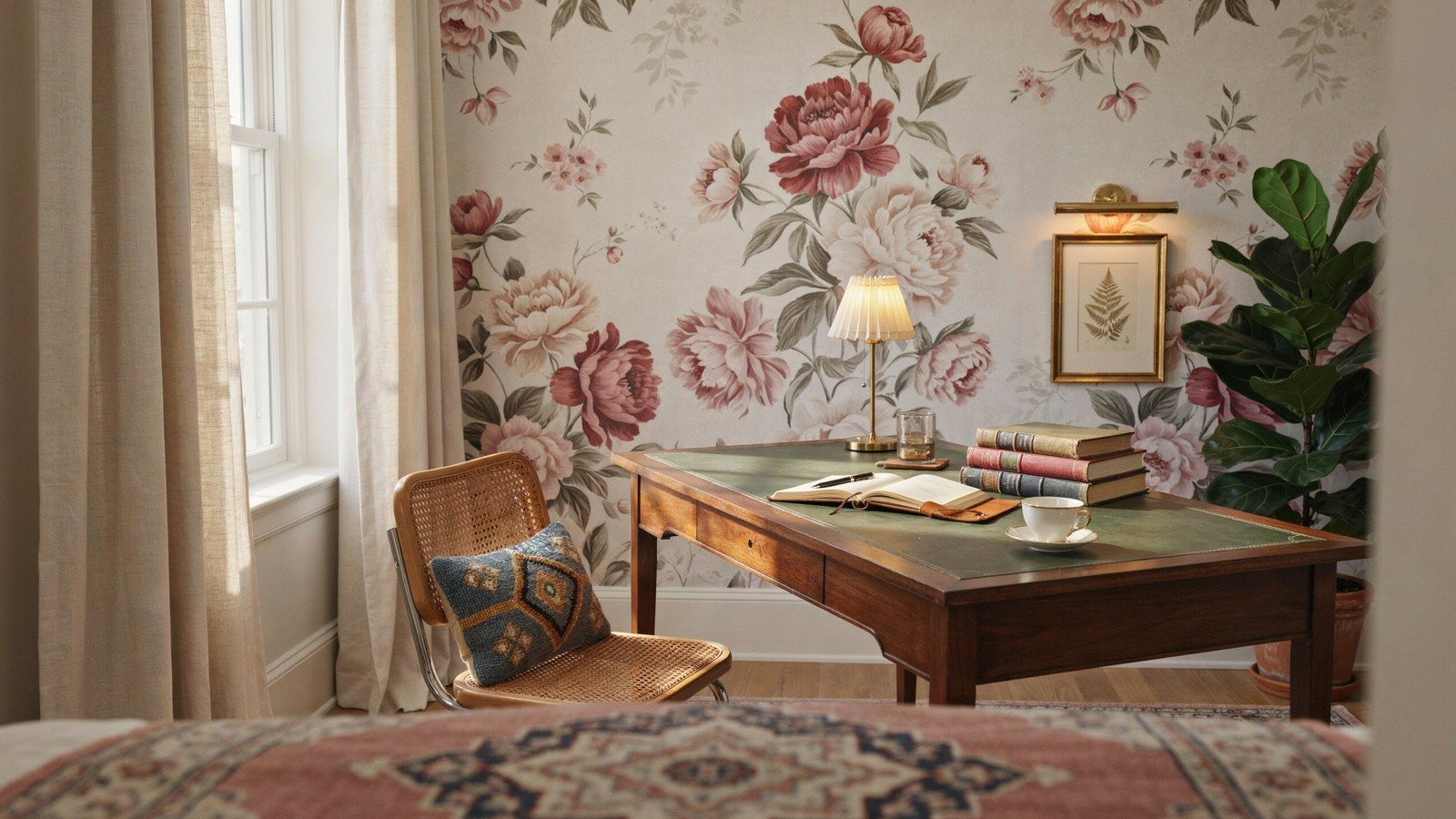
A grandmillennial office works when the pattern is confident and the desk still functions. Florals on the walls, something inherited in the corner, and a chair you can actually sit in for six hours. The trap is decorating a room you then cannot work in.
My own version started as a spare bedroom with a folding table and a chintz armchair I could not part with. The armchair turned out to be the whole scheme, and everything since has been chosen to sit beside it. That is usually how these rooms begin.
Below is the process in fifteen steps, from choosing the anchor pattern through to hiding the cables. Some steps are a weekend, some are a slow hunt through junk shops. The order matters more than the budget.
What Grandmillennial Means In A Working Room
Grandmillennial takes the things minimalism threw out and puts them back deliberately. Chintz, skirted tables, brass picture lights, needlepoint, brown furniture and pattern on pattern. The style is unapologetically decorative, which sits awkwardly with a room that has to hold a monitor.
The resolution is to treat the technology as the thing that hides and the decoration as the thing that shows. A laptop closes, a monitor can sit on a stack of books, and cables can vanish behind a skirt. The room reads as a study rather than a desk setup.
The other half is provenance. Grandmillennial rooms look right when the objects have history, real or plausible, so a junk shop lamp beats a new one from a catalogue every time. Buying the whole room new is the fastest way to make it look like a showroom.
| Element | Grandmillennial Choice | What Breaks It |
|---|---|---|
| Walls | Floral paper or a strong painted colour | Flat white throughout |
| Desk | Antique writing table or skirted table | Modern sit stand in bare metal |
| Chair | Upholstered, caned or spindle back | Mesh office chair in black plastic |
| Lighting | Brass picture light and a table lamp | Ceiling downlight grid |
| Storage | Painted bookcase, closed boxes | Open wire shelving |
| Textiles | Skirt, curtain, needlepoint cushion | No fabric at all, hard surfaces |
Where To Put An Office Like This
The style suits small rooms far better than large ones because pattern needs enclosure to work. A box room, a wide landing or a converted cupboard all take florals happily. A big open room needs a great deal more pattern before it reads as intentional.
Natural light matters more here than in a minimal office because the colours are richer and the surfaces less reflective. A room with one decent window will carry a dark floral, while a windowless space will need the pattern kept pale. Judge the paper against your actual light before ordering.
Think about what is behind you on video calls, since that is the part of the room other people see most. A bookcase, a picture light and a piece of the floral is the ideal backdrop. A blank wall or a radiator is a wasted opportunity.
1. Choose The Anchor Pattern First
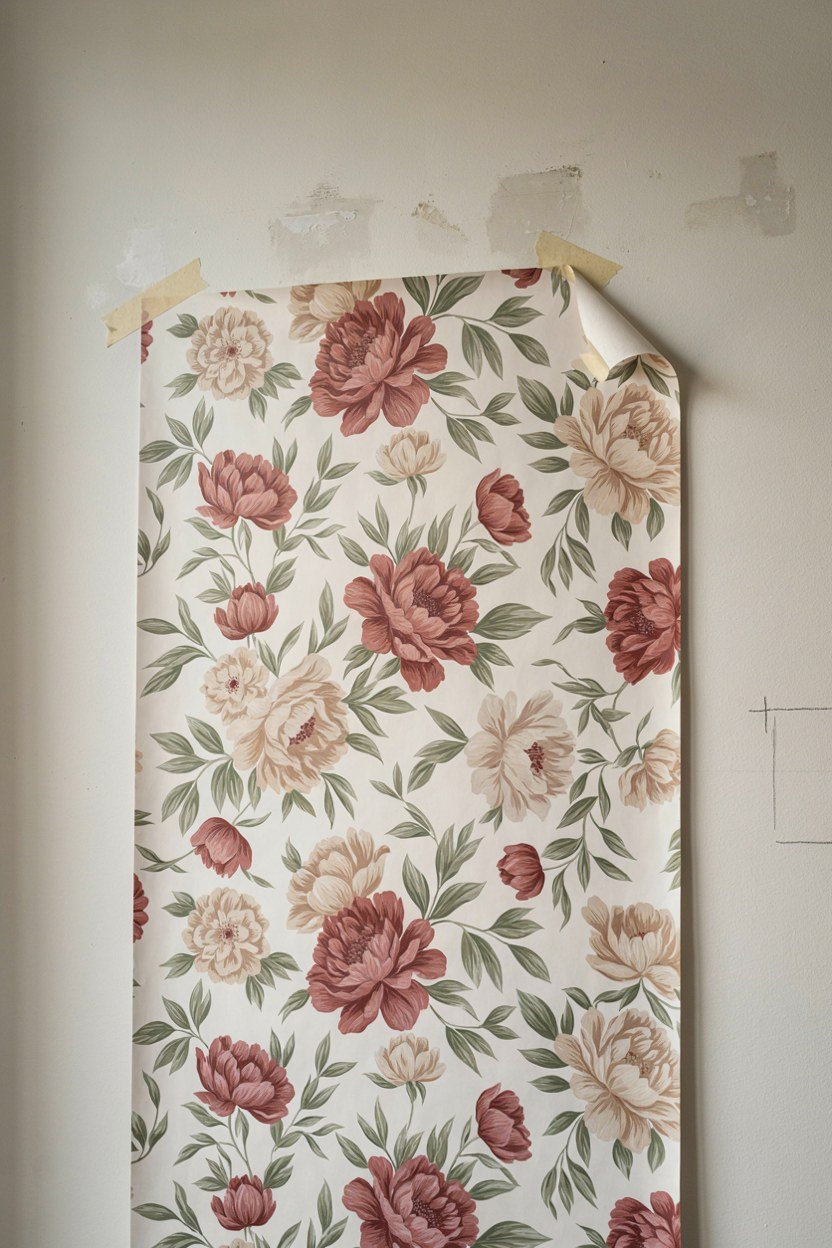
Everything else in the room reacts to the main pattern, so choose it before the paint, the desk or the chair. A floral wallpaper is the usual anchor, but a large scale fabric for curtains works just as well. Pick it and let it dictate the palette.
Take three colours from the pattern and use them everywhere else. That is the whole colour scheme, and it removes almost every subsequent decision. A pattern with too many colours to do this is too busy for a small office.
Order a full roll length sample rather than an A4 swatch. Large scale florals repeat over a considerable distance and a small square tells you nothing about how the pattern reads on a wall. Tape it up and live with it for a week.
Buy an extra roll beyond the calculation and keep it. Papers are discontinued constantly, and a single damaged drop years later is unfixable without a matching roll. Store it flat somewhere dry rather than upright in a loft.
Judging Scale Against The Room
Small rooms can take large scale patterns, which surprises people. A big floral in a box room reads as confident, while a tiny sprig pattern in the same space reads as a doctor’s waiting room. Err towards larger.
Check where the repeat falls on your main wall. A pattern with a dominant motif every 60cm can look awkward if it lands badly against a window or a bookcase. Hold the sample where the wall actually is.
2. Paper One Wall Or All Four, Never Two
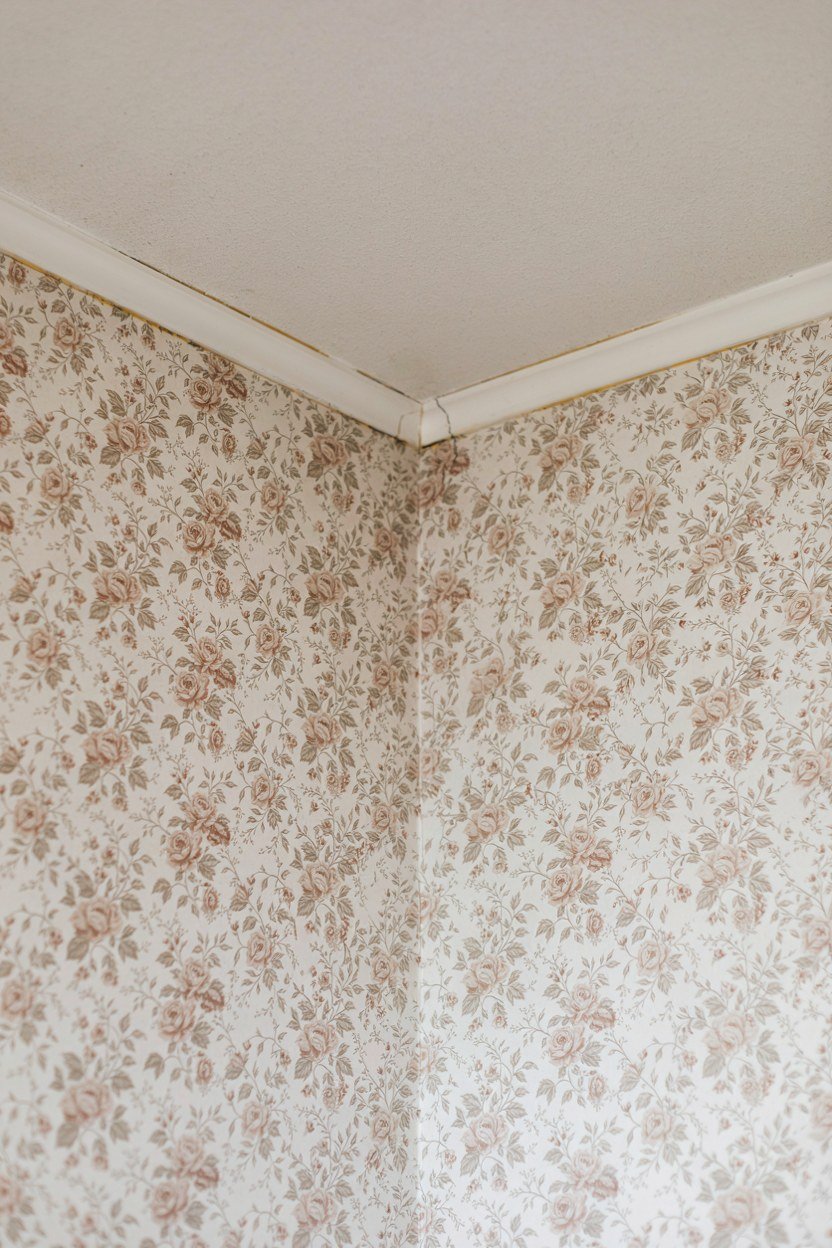
Two papered walls in a small room look like the roll ran out. Either commit to the whole room or treat one wall as a feature with the others painted from the same palette. Both work; the halfway version does not.
Papering all four walls in a small office is the more convincing choice and it is what the style calls for. The enclosure is the point, and pattern wrapping the corners is what makes a room feel like a decorated space rather than a wall with paper on it. Wrapping paper around a corner is what turns a decorated wall into a decorated room.
If four walls feels like too much, paper the wall behind the desk. You will see it least while working and most on camera, which is exactly the right distribution. It is also the cheapest way to test whether you can live with the pattern.
Taking It Onto The Ceiling
Papering the ceiling as well is the most grandmillennial move available and it works best in a very small room. It removes the visual stop at the cornice and makes the space feel like a jewel box. It also hides a bad ceiling.
If that feels like a step too far, paint the ceiling in the palest colour from the paper. It ties the room together without the commitment, and it is a great deal easier to change later. A painted ceiling can be changed in an afternoon, which paper cannot.
3. Find A Desk With Legs, Not A Box
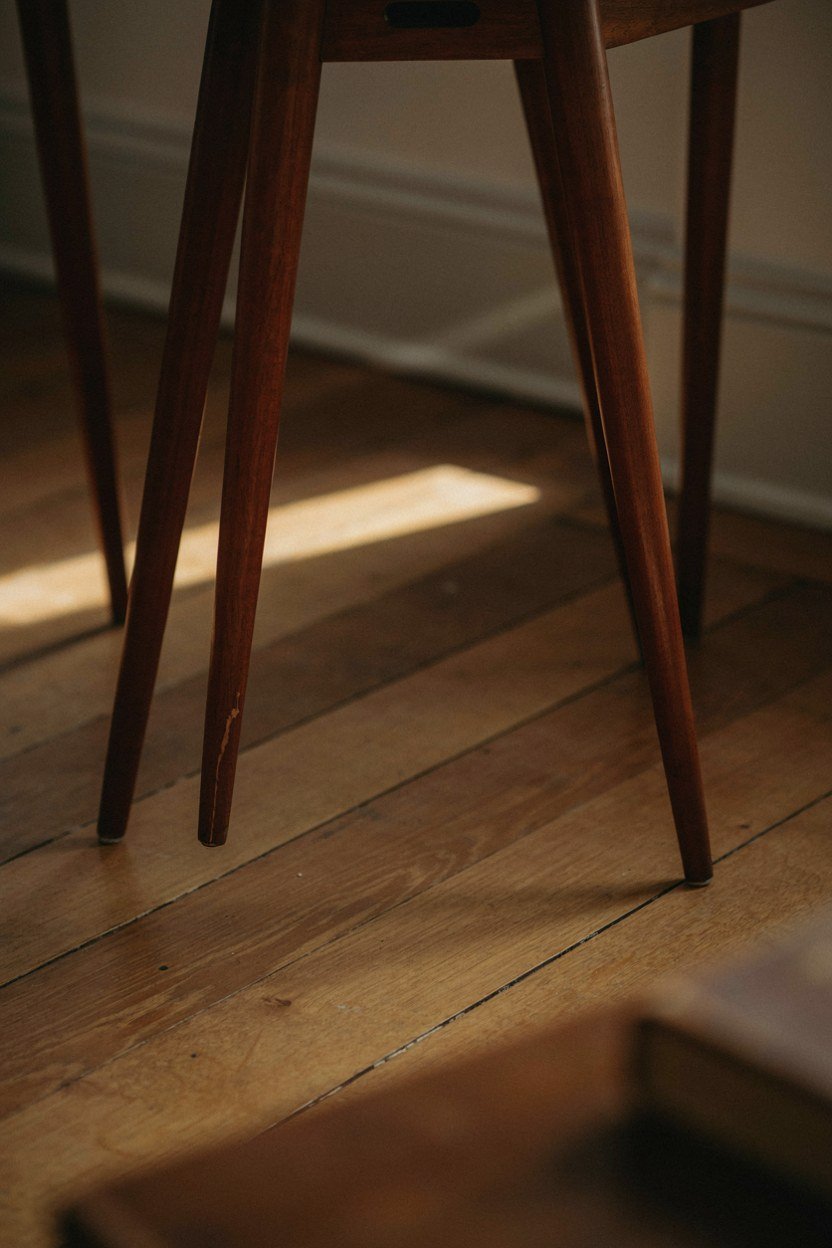
A writing table on four visible legs suits this style far better than a modern desk with drawer pedestals. The floor running underneath keeps a small room open, and the shape reads as furniture rather than office equipment. Antique writing tables are still cheap.
Look for something around 120cm wide and 60cm deep, which is enough for a monitor and a notebook. Anything larger dominates a small room, and anything smaller stops being usable. Measure before falling in love.
Check the height before buying, because antique tables run lower than modern desks. Around 73cm is comfortable for typing, and many Victorian tables sit at 70cm or below. A low desk causes shoulder trouble within weeks.
Check the desk sits square against whichever wall you intend, because antique tables are rarely true. A packing shim under one leg costs nothing and stops the wobble that makes a desk unpleasant to write at. Do it before the room is dressed.
When To Use A Skirted Table Instead
A round table with a floor length skirt is the classic grandmillennial desk and it solves the storage problem entirely. Everything ugly lives underneath, hidden by fabric. It is also the cheapest option, since the base can be a plywood top on a cheap frame.
Make the skirt in the same fabric as a curtain or a cushion so it reads as deliberate. A skirt in an unrelated fabric looks like a cover up, which is precisely what it is and precisely what it should not look like. Repeating one fabric twice in a small room is usually enough to tie it together.
4. Buy The Chair For Eight Hours, Not For Looks
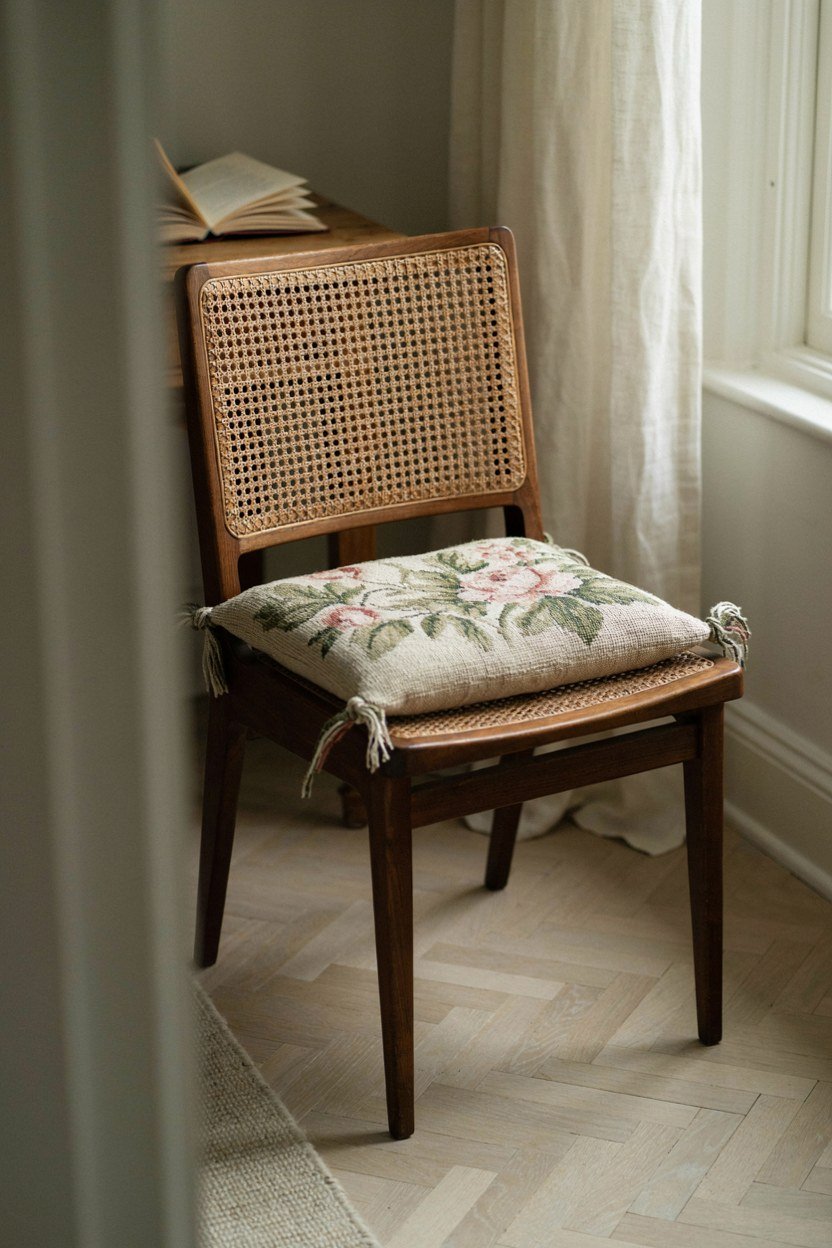
This is the one place I would break the style if forced to choose. A beautiful chair that hurts after an hour means you stop using the room, and an unused office is a failed one. Comfort first, appearance second.
The good news is that comfortable and decorative are not opposites. A caned back desk chair with a proper seat pad, or a small upholstered armchair with arms low enough to slide under the desk, both work. Look for a seat depth around 45cm.
Add a cushion rather than accepting a hard seat. A needlepoint or trimmed cushion is entirely in keeping with the style and it fixes most comfort problems. Tie it on so it stays put.
Put the chair on castors that suit the floor rather than whatever it came with. Hard castors on timber will scar it within months, and soft ones on a rug will not roll at all. Replacement castors are cheap and take ten minutes.
If You Need A Modern Task Chair
Buy one and slipcover it. A plain calico or floral cover over a mesh chair is a well established trick and it takes an afternoon to make. The mechanism keeps working and the black plastic disappears.
Failing that, choose a task chair in a muted colour with a timber base. Several manufacturers now make them, and a walnut base with a wool seat sits far better in this room than black nylon. It costs more and it is the honest compromise.
5. Use A Picture Light Over The Desk
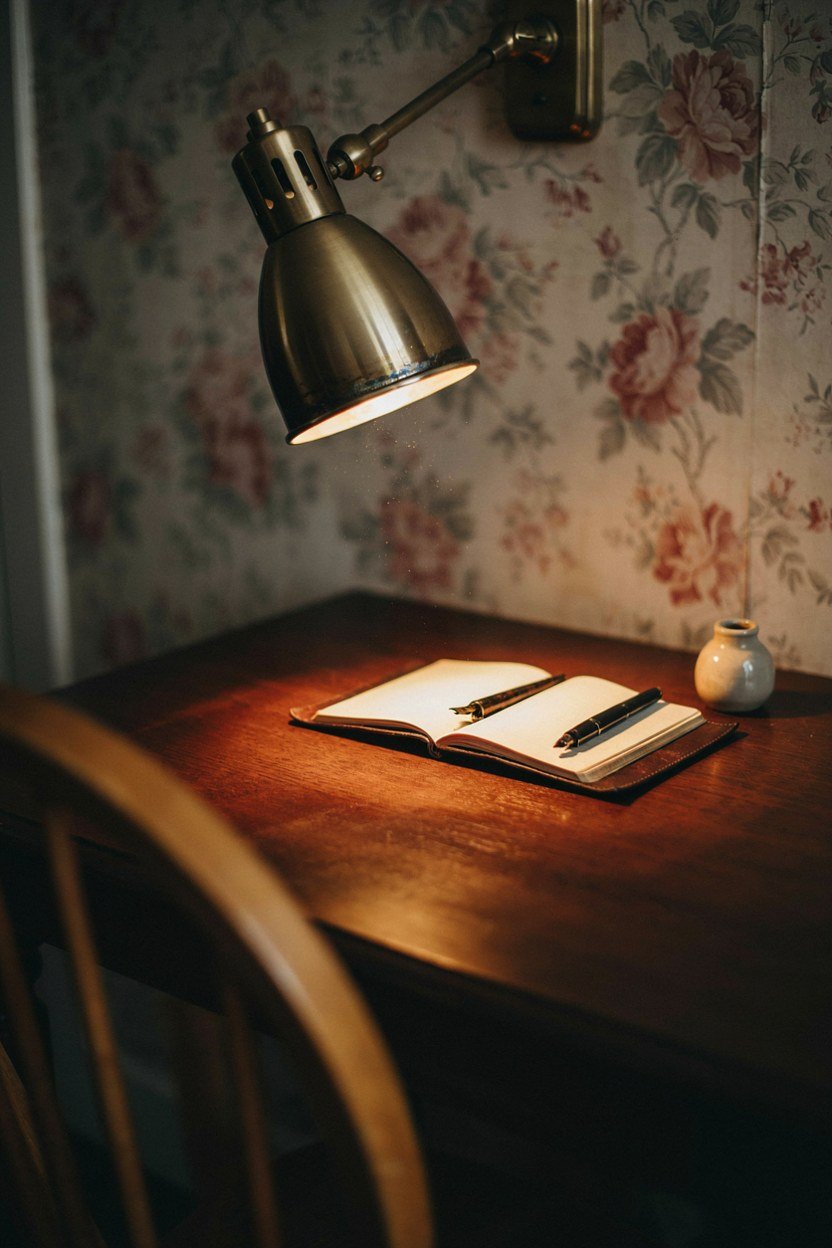
A brass picture light mounted above the desk gives you task lighting that looks like decoration. It throws light down onto the work surface without the flatness of a ceiling fitting. It is the single most characteristic light in this style.
Mount it slightly higher than you would over a painting, around 40cm above the desk surface. Too low and it sits in your sightline, too high and the light spreads too thin. Hold it in place before drilling.
Choose one with an adjustable arm if you can. Fixed picture lights aim at a specific spot and a desk needs a wider pool. The adjustment is worth the small extra cost.
Put the desk lamp on the opposite side to your writing hand. A lamp on the same side casts a shadow across the page from your own arm, which is the sort of thing you notice only after living with it. Left of a right hander, and the reverse.
Adding A Second Source
A table lamp on the desk or a bookcase gives you the low warm light that makes the room usable in the evening. Two sources at different heights is the minimum for a room this decorated. Flat overhead light kills pattern.
Use warm bulbs at 2700K throughout. Cool light makes florals look faded and turns brown furniture grey, which undoes the entire scheme. This matters more here than in a plain room.
6. Bring In One Piece Of Brown Furniture
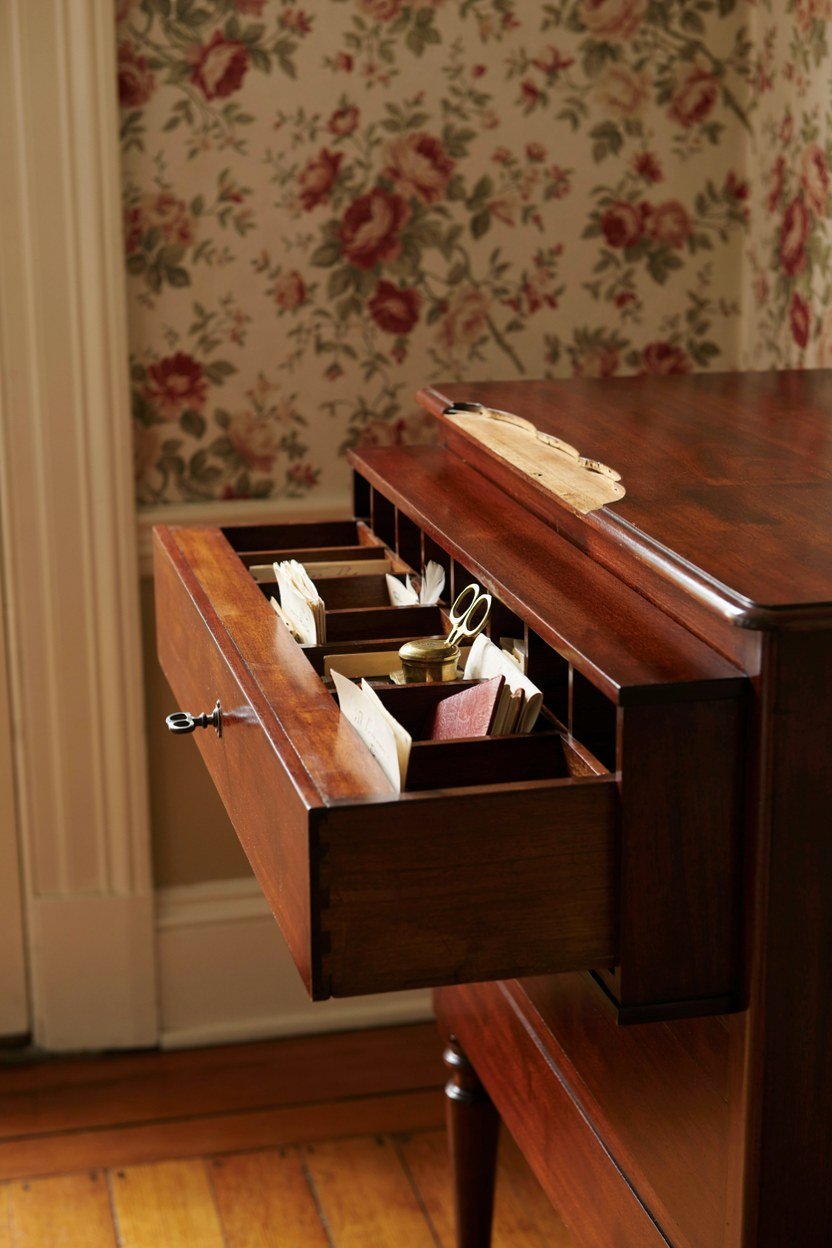
Brown furniture is the backbone of the style and it is currently the best value in any junk shop. A bureau, a small chest or a bookcase in mahogany or walnut gives the room the weight that new furniture cannot. One good piece is enough.
Do not paint it. The instinct is to lighten dark wood, and it removes the exact quality that makes the room work. A polished antique against a floral wall is the whole look.
Look for something with useful storage rather than pure display. A bureau with a drop front gives you a second work surface and a home for stationery, which a display cabinet does not. Function keeps the room in use.
Measure the doorway and the stair turn before bidding on anything large. Brown furniture was built for houses with wider openings, and a wardrobe that cannot reach the room is a common and expensive lesson. Take the measurements with you.
Where To Find It Cheaply
House clearance auctions and local marketplace listings are full of brown furniture that nobody wants. Prices for anything not made by a known maker are very low, and the quality is usually far above modern equivalents. Delivery is the real cost.
Check the drawers run and the veneer is not lifting before committing. Loose veneer is repairable and expensive to have done, while sticking drawers usually need nothing more than a candle rubbed on the runners. Ask the seller to open every drawer while you are there rather than after delivery.
7. Add A Skirted Or Ruffled Textile Somewhere
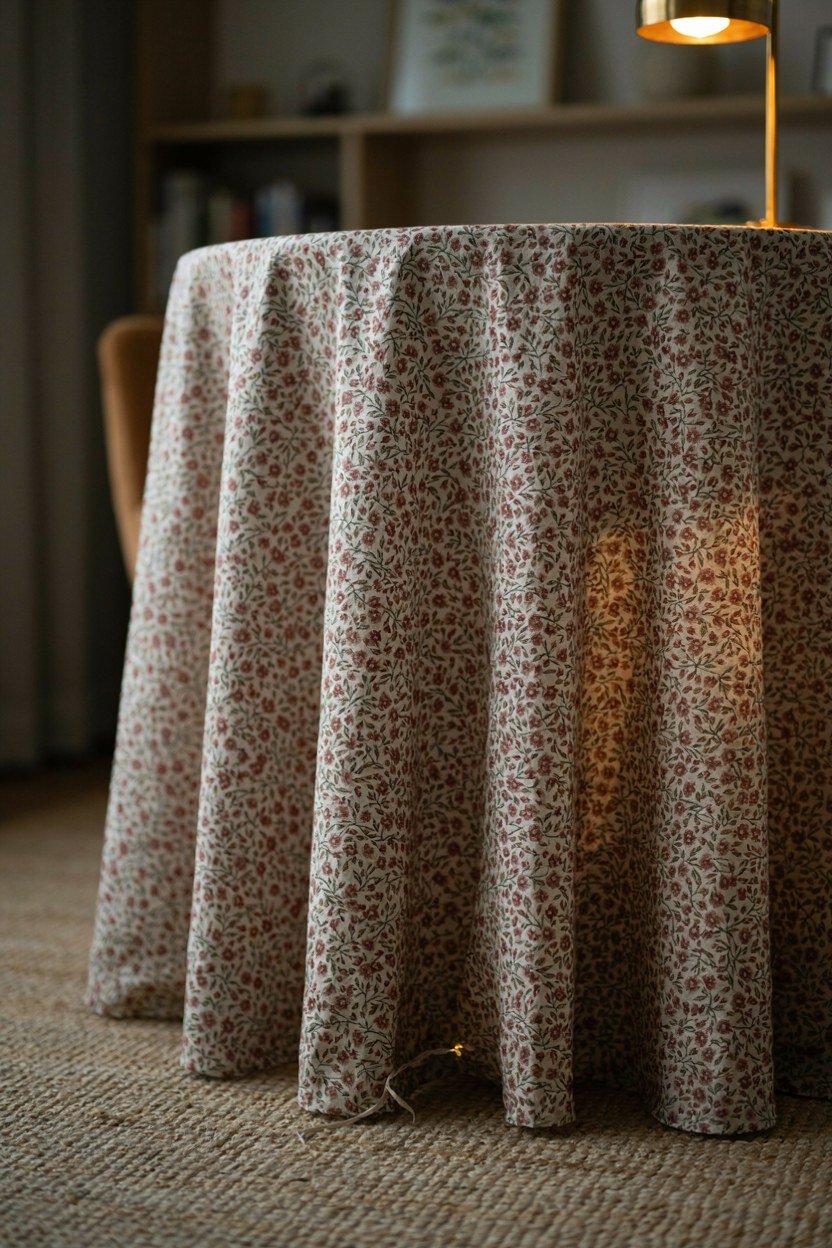
Fabric is what separates grandmillennial from ordinary traditional decorating. A skirted table, a ruffled lampshade or a gathered curtain adds the softness the style depends on. One substantial fabric element is the minimum.
Ruffles and scallops read as deliberate rather than fussy when the rest of the room is disciplined. The mistake is adding them everywhere. One ruffled shade in a room of straight lines is charming; six is a costume.
Choose a fabric that picks up a secondary colour from the anchor pattern. Matching the main colour exactly makes the room flat, while pulling out a minor colour makes the whole scheme look considered. That small shift is what stops a single pattern scheme feeling one note.
Leave a gap at the back so you can reach the cables and sockets behind. A skirt sewn as a closed circle looks neat and makes the space underneath useless. An overlap at the rear solves both problems at once.
Making A Simple Table Skirt
A table skirt is a rectangle of fabric gathered onto a tape and attached with hook and loop tape. It needs no sewing skill beyond a straight line and it takes an afternoon. Allow twice the circumference of the table for a proper gather.
Line it if the fabric is light, because unlined skirts hang limply and show whatever is behind them. A cheap cotton lining doubles the quality of the result for very little money. Lining also stops sunlight fading the face fabric unevenly over a few summers.
8. Hang Plates Or Botanical Prints
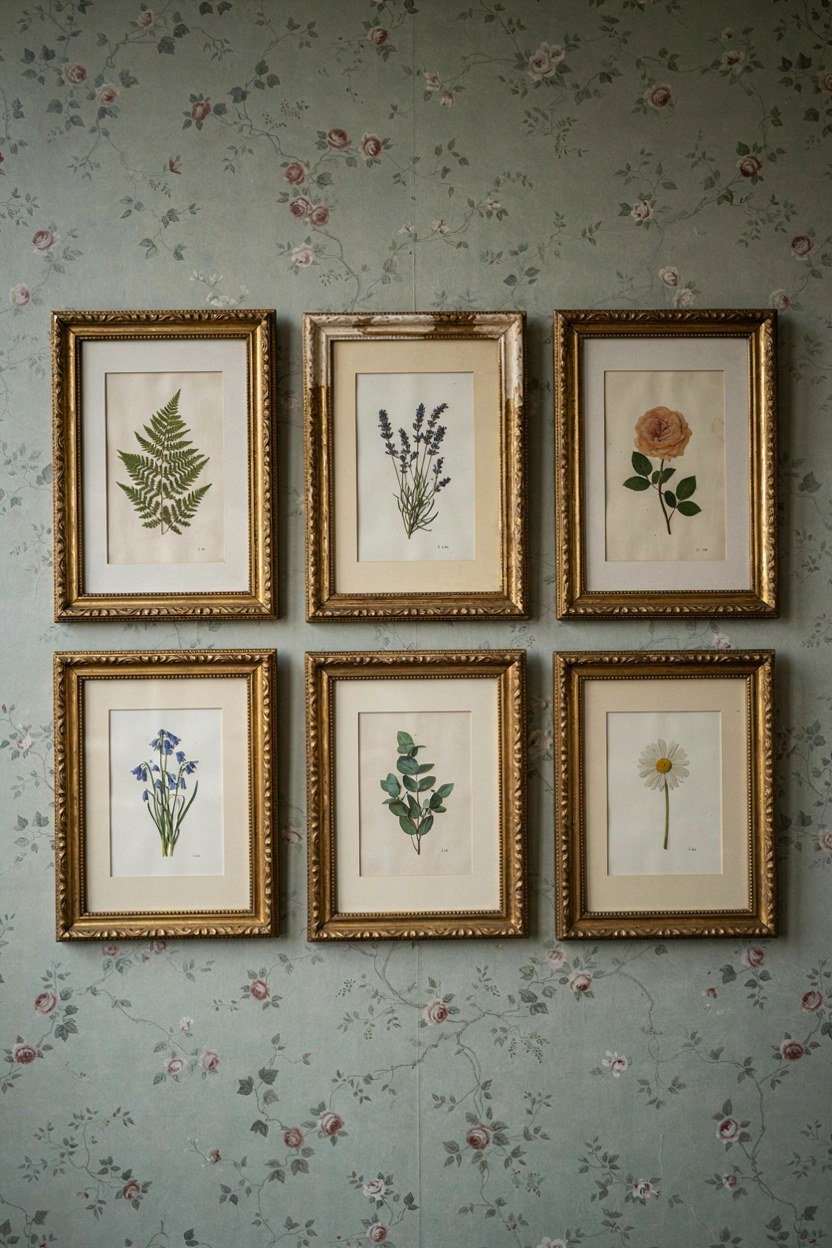
Wall decoration in this style leans towards collections rather than single statements. A group of blue and white plates, a set of botanical prints or a cluster of small gilt frames all fit. The repetition is what makes it read as intentional.
Hang them tightly, with gaps of around 5cm between frames. Widely spaced groupings look accidental, while a tight arrangement reads as one object. Lay the whole group out on the floor first.
Use one framing style throughout the group. Mixed frames can work in a large collection built over years, but in a new arrangement they look like whatever was to hand. Consistency now, variety later.
Hang the group before the desk goes in, while you can still stand back properly. Arranging frames over a desk means leaning across it, and the result is almost always hung slightly too high. Clear floor makes for better hanging.
Hanging Onto Wallpaper
Use the smallest fixing that will hold, because every hole in wallpaper is permanent. Picture hooks with fine pins do less damage than screws and hold surprisingly well for light frames. Plan the whole arrangement before the first pin goes in.
Mark positions with low tack tape rather than pencil. Pencil marks on paper are difficult to remove and often show through pale grounds. Tape lifts cleanly.
9. Keep The Technology Out Of Sight
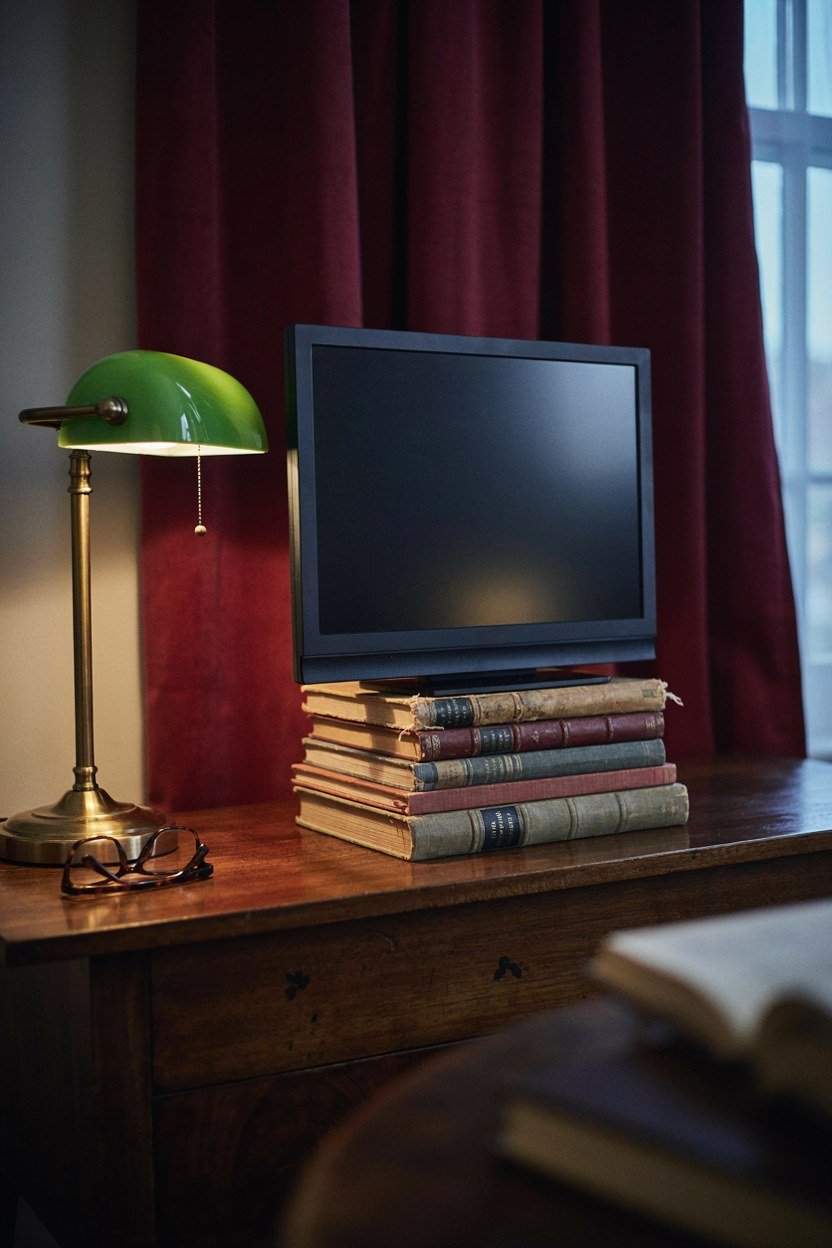
The monitor is the hardest object to reconcile with this style and there is no perfect answer. The practical options are to use a laptop that closes, to place the monitor against a bookcase so it reads as part of the shelving, or to accept it and dress around it. Whichever route you take, decide it before the desk position is fixed.
Cables are easier and they matter more than people think. A trailing cluster of black cables undoes a carefully decorated room instantly. Run them through a fabric sleeve or behind the table skirt.
A printer belongs in a cupboard. There is no version of this style in which a printer looks good on a shelf, and they are large enough to dominate a small room. Closed storage or another room entirely.
Match the monitor bezel to something else dark in the room if you can. A black rectangle beside a black lamp base and a dark frame reads as part of a scheme, while a lone black object in a warm room reads as an intrusion. Repetition is what makes an awkward object read as part of the scheme.
Dressing Around A Monitor
Put the monitor on a stack of books rather than a modern stand. It raises it to the right height, it looks entirely in keeping, and it costs nothing. Choose books with cloth bindings for the best effect.
Place a lamp and a small object either side to break up the rectangle. A monitor flanked by nothing reads as equipment, while one framed by a lamp and a vase reads as part of the arrangement. The asymmetry of a lamp on one side and something low on the other works best.
10. Use A Painted Bookcase, Not Open Shelving
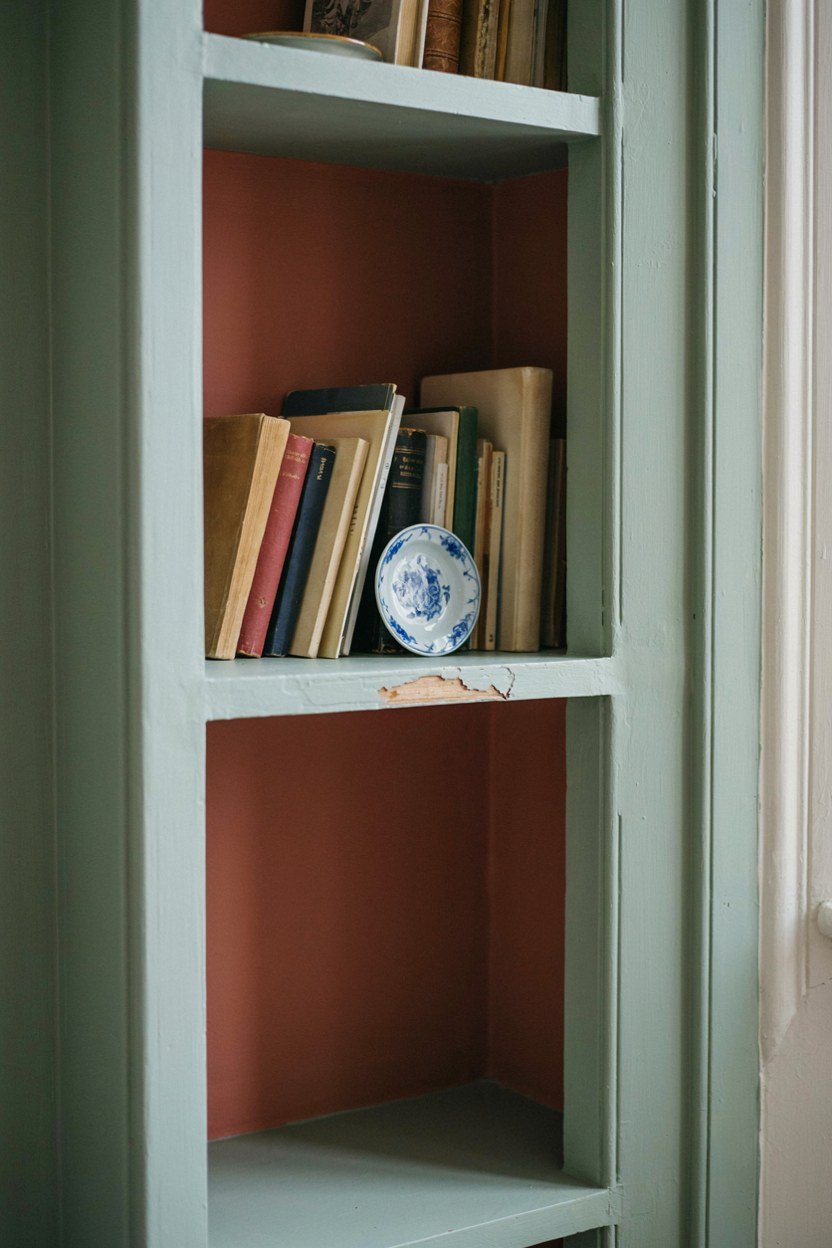
A bookcase painted in a colour from the anchor pattern gives you storage that belongs to the scheme. Open wire or bracket shelving reads as utility and fights everything else in the room. The bookcase should look like furniture.
Paint the back panel a contrasting colour from the palette. It is a small amount of work and it makes the shelves read as a designed object rather than a container. Books look better against a colour than against white.
Leave roughly a fifth of the shelf space free. Full shelves look like storage and slightly empty ones look like a library. That gap is what stops the room feeling crowded.
Styling Shelves Without Clutter
Group books by colour if you like the look, but keep at least one shelf arranged by subject so the room stays usable. A study where you cannot find a book is decoration rather than an office. A study you cannot navigate stops being a study within a month.
Add one object per shelf rather than several. A single piece of china or a small framed photograph between books is enough, and more than that becomes a display that needs dusting. Restraint on the shelves is what lets the wallpaper stay the loudest thing in the room.
11. Put A Curtain On The Window, Not A Blind
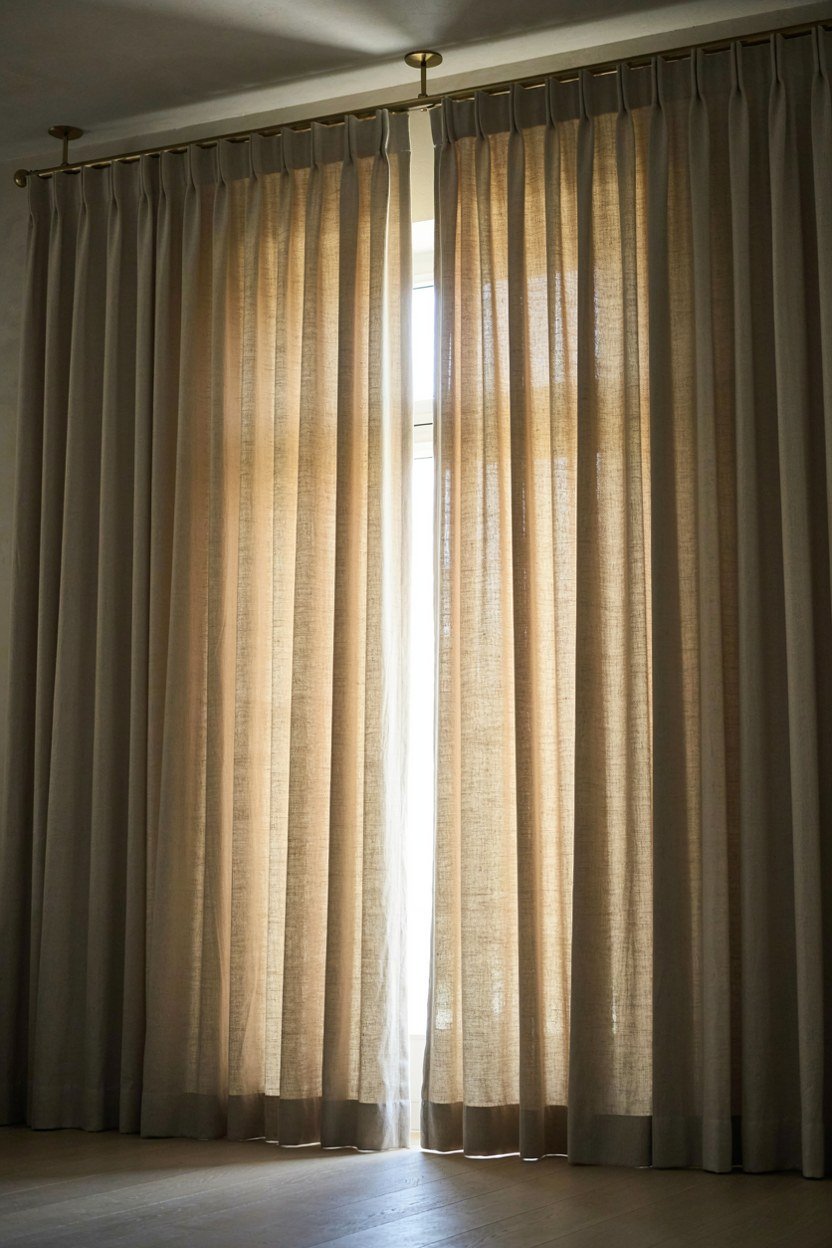
Curtains suit this style and blinds do not, because the fabric volume is part of the look. Floor length curtains in a plain fabric from the palette let the wallpaper stay the star. Patterned curtains against patterned walls need real confidence.
Hang the pole close to the ceiling and extend it well past the window on both sides. It makes the window look larger and it lets the curtains stack off the glass, which matters in a room that needs its daylight. The stack of fabric then sits on wall rather than over glass.
Interline them if the room is cold. A study used for long stretches in winter benefits from the insulation, and the extra weight makes the curtains hang far better. Interlining also gives a fuller drape, which suits the style considerably better.
If A Blind Is Unavoidable
Choose a roman blind in a fabric rather than a roller. The folds give you some of the softness that curtains provide, and the fabric can pick up a colour from the paper. Rollers read as office equipment.
Add a fabric pelmet above it if the window is plain. It hides the mechanism and gives the window the architectural weight the style expects. A simple gathered pelmet is a beginner sewing project.
12. Add One Unexpected Colour

Every scheme built from a single pattern risks becoming monotonous. One colour from outside the palette, used once, stops that happening. A scarlet lampshade in a blue room, or a chartreuse cushion against pink, gives the eye a jolt.
Keep it to one object and keep that object small. The purpose is a punctuation mark, not a second scheme. Two unexpected colours cancel each other out.
Choose something you can move or replace easily. This is the element most likely to feel wrong in six months, and a cushion or a shade is a cheap change. Do not paint a wall in it.
Judging Whether It Works
Live with it for a fortnight before deciding. A jolt of colour often looks wrong on the first day and right by the second week, because the eye adjusts to the scheme around it. Snap judgements here are usually mistakes.
If it still jars, move it rather than removing it. The same object often works in a different position, particularly further from the main pattern. Position matters as much as the colour itself.
13. Hunt For The Accessories Rather Than Buying Them
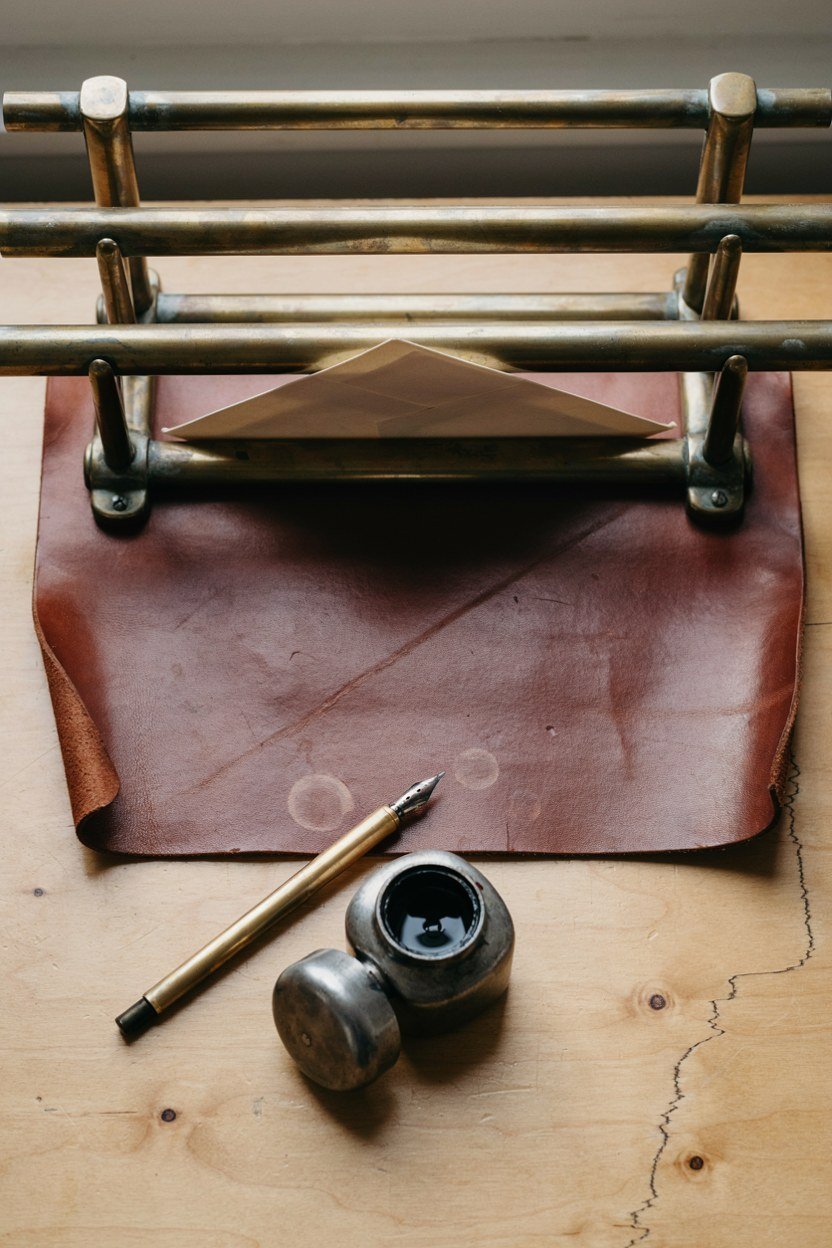
The difference between a grandmillennial room and a catalogue version is that the objects were found rather than ordered. A brass letter rack, a chipped Staffordshire dog, a needlepoint cushion someone else made. These cannot be bought as a set.
Give yourself permission to leave gaps while you look. A room finished slowly looks collected and a room finished in one delivery looks staged. The empty spot on the shelf is temporary.
Set a small budget per object and stick to it. The pleasure of this style is the hunt, and paying dealer prices for everything removes both the pleasure and the point. A cap per item keeps the hunt going rather than ending it with one purchase.
What To Look For First
A desk lamp, a letter rack and a wastepaper bin are the three objects you will use daily, so find good ones early. Vintage versions of all three are common and cheap. They also set the tone for everything after.
Avoid anything reproduction. A new object made to look old sits badly beside genuinely old ones, and the difference is obvious in person even when it is not in photographs. Genuine wear reads differently to manufactured distressing, and the eye catches it immediately.
14. Layer A Rug Over The Existing Floor
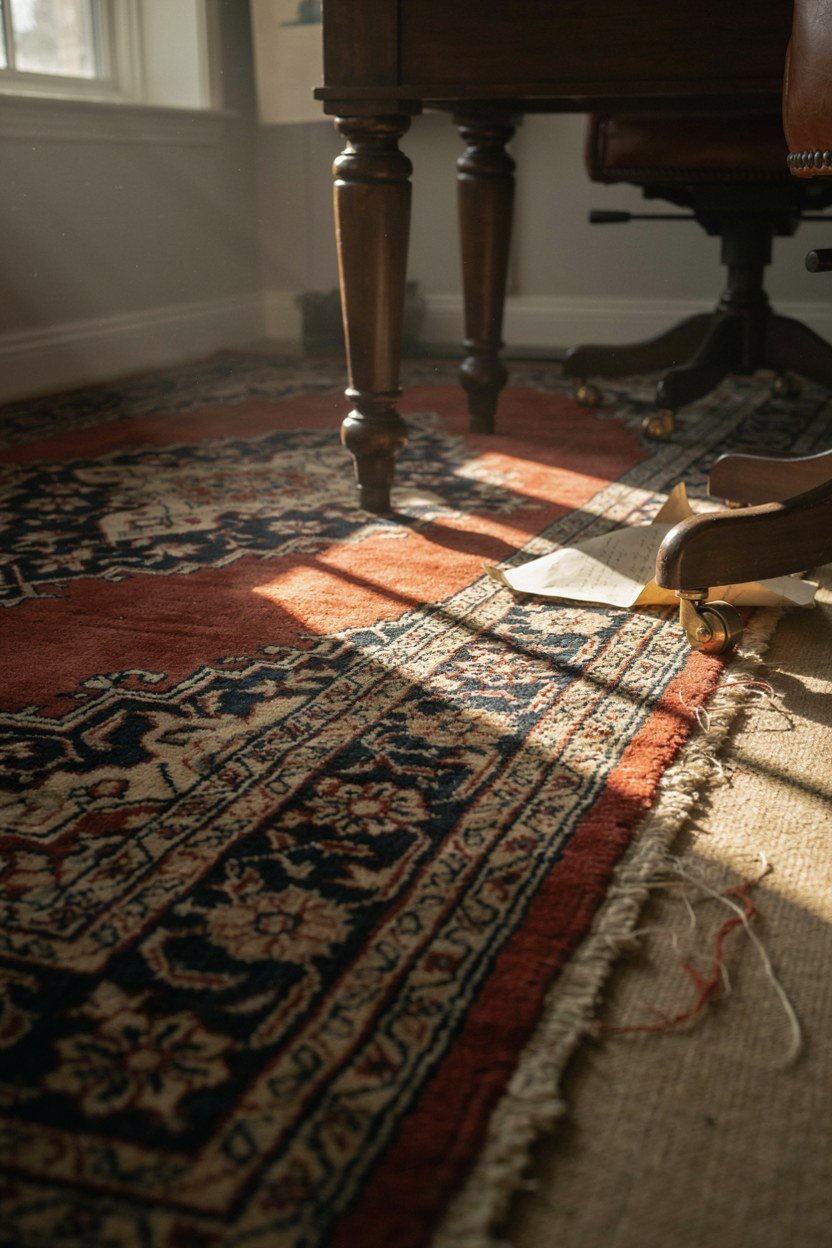
A rug anchors the desk and adds another pattern layer without any decorating work. An antique or antique style rug in wool suits the room and hides a poor floor. It also warms a room that is often the coldest in the house.
Size it so the desk and the chair both sit on it, with the chair still on the rug when pushed back. A rug too small for the chair to roll on becomes a trip hazard and looks mean. Measure the chair at full push back rather than guessing.
A worn rug is better than a new one here. Faded patterning and visible wear are exactly right for the style, and they cost considerably less than a new equivalent. Older rugs also lie flatter, which matters under a chair on castors.
Pattern On Pattern Without Chaos
The rug and the wallpaper can both be patterned provided they differ in scale. A large floral on the wall and a small dense pattern underfoot read as layered, while two patterns at the same scale fight. Vary the scale, keep the palette.
Keep the colours related. A rug that shares two colours with the wallpaper will sit comfortably even if the patterns are quite different in character. Shared colour does the reconciling.
15. Deal With The Cables Before You Finish
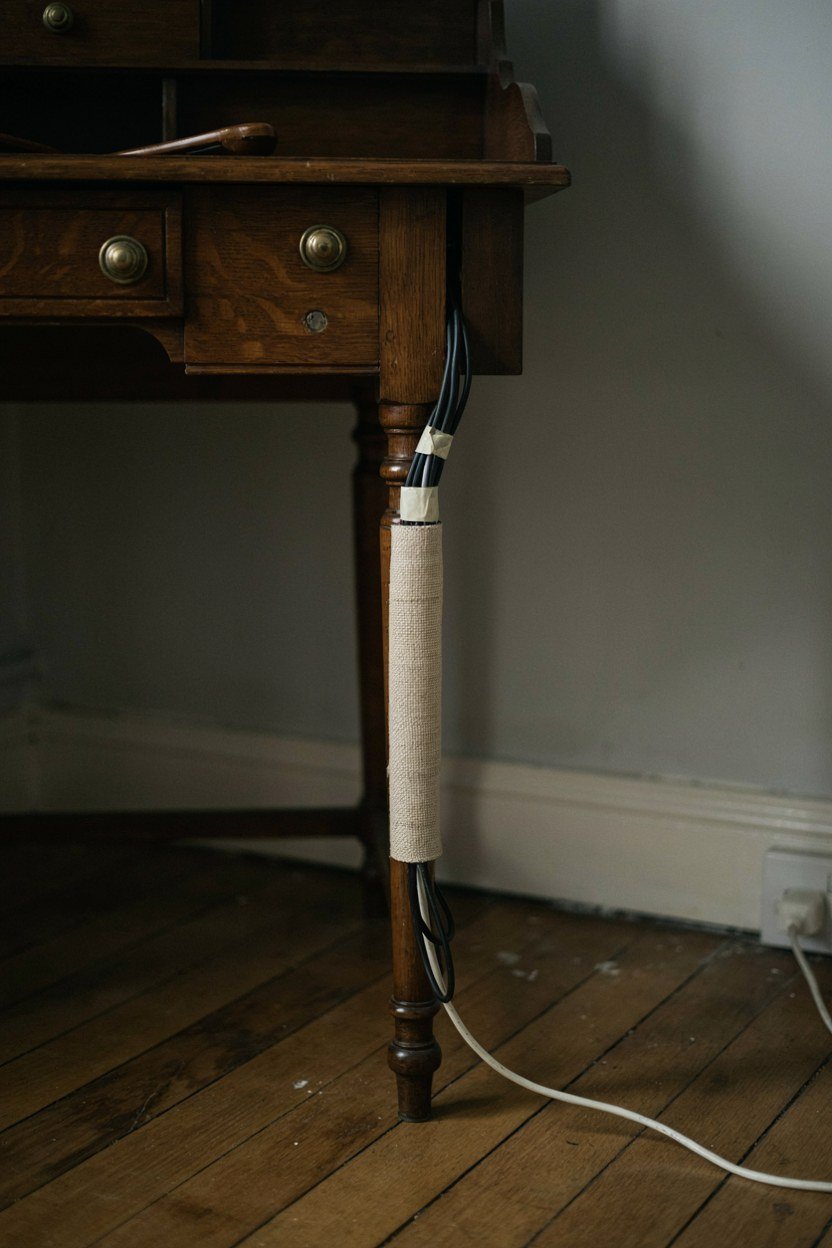
Cable management is the least decorative item on this list and the one that determines whether the room looks finished. A beautiful office with a nest of black cables under the desk is not a finished room. Sort it before you hang the last picture.
A trunking channel run down the back leg of the desk and painted the wall colour handles the visible drop. Under the desk, a cable tray screwed to the underside holds the adapters out of sight. Paint it before fitting rather than after, since brush marks show badly on plastic.
Buy one extension lead with a long enough cable to reach the socket properly. Daisy chained short leads are both untidy and a genuine hazard, and they are what most home offices end up with. Measure the run before ordering, because a lead half a metre short is useless.
Hiding A Router
Routers are ugly and they need to be in the open to work properly. A woven basket with an open back, or a shallow box with the rear panel removed, solves it without blocking the signal. Do not put it in a metal container.
Label the cables at both ends while you are down there. A strip of masking tape and a pen saves a considerable amount of crawling around later. Nobody regrets doing this.
What A Grandmillennial Office Costs
The wallpaper is usually the single largest cost and it is where the character comes from. A small room takes four or five rolls, and good paper is not cheap, but nothing else changes a room as completely. This is where I would spend.
Furniture should cost very little if you are willing to hunt. Brown furniture is at a historic low, and a decent writing table and bookcase can be found for less than one new desk. Patience replaces budget here.
Lighting and textiles sit in the middle and both give a strong return. A picture light, a table lamp and a made skirt together cost less than a sofa and they carry a great deal of the style. Between them they carry the evening character of the room entirely.
| Element | Priority | Rough Cost |
|---|---|---|
| Anchor wallpaper or fabric | Sets the entire scheme | Mid to high |
| Comfortable chair | Decides whether the room gets used | Mid |
| Brown furniture, found | Backbone of the style | Low if hunted |
| Picture light and table lamp | Makes the room work after dark | Low to mid |
| Table skirt, curtains, cushions | Softness the style depends on | Low to mid |
| Rug, ideally worn | Anchors and warms the room | Mid |
| Cable management | Unglamorous, decides if it looks finished | Low |
The Mistakes That Make It Look Like A Costume
The most common mistake is buying the whole room at once from one supplier. Everything matches, nothing has history, and the result reads as a themed hotel room. The style depends on objects arriving at different times from different places.
The second is choosing pattern without a palette. Three unrelated florals in one small room is chaos rather than layering, and the fix is to pull every colour from the anchor pattern. Discipline in colour is what allows freedom in pattern.
The third is decorating a room you cannot work in. A low antique chair, no task light and a desk full of ornaments makes a lovely photograph and a useless office. The room has to survive a full working day.
The Test That Catches All Three
Work in the room for a week before adding anything else. Discomfort, bad light and missing storage all announce themselves quickly, and every one of them is easier to fix before the room is finished. A week of real use tells you more than any amount of planning on paper.
Then photograph it and count how many objects look newly bought. If the answer is most of them, stop buying and start hunting. Time is the ingredient that cannot be purchased.
Conclusion: Three Decisions That Carry The Room
Choose the anchor pattern first, take three colours from it, and buy a chair you can sit in all day. Those three decisions determine whether the room looks collected and whether you actually use it. Everything else on this list follows from them.
Then protect the working half. Task light over the desk, cables managed, printer hidden and one clear surface to write on. A study that functions will keep earning its decoration.
Finally, leave gaps and fill them slowly. The style depends on objects that were found rather than ordered, and that takes months rather than an afternoon. A room finished too quickly always shows it.
Frequently Asked Questions About Grandmillennial Offices
What makes a room grandmillennial rather than just traditional?
Deliberate revival rather than inheritance. Chintz, skirts, ruffles and brown furniture chosen on purpose by someone who could have chosen minimalism.
Can I use a modern task chair in this style?
Yes, slipcovered in a plain or floral fabric. Comfort matters more than period accuracy in a room you work in daily.
Should I paper all four walls or just one?
All four in a small room, or one behind the desk. Two papered walls almost always looks like the roll ran out.
How do I hide a monitor in a decorated office?
Raise it on a stack of cloth bound books and flank it with a lamp and an object. A laptop that closes is easier still.
Where do I find affordable brown furniture?
House clearance auctions and local marketplace listings. Prices are historically low and delivery is usually the largest part of the cost.
How many patterns can one small office take?
Two or three, provided they differ in scale and share a palette. Same scale patterns fight each other regardless of colour.
What lighting suits a grandmillennial office?
A brass picture light over the desk and a warm table lamp, both at 2700K. Overhead downlights flatten pattern and drain brown furniture.